

 CN
CN
Cefradine for Injection
Instructions for Cefradine for Injection
Please read the instructions carefully and use under the guidance of a physician.
This product is
contraindicated for people who are allergic to cephalosporins and those
who have a history of penicillin anaphylactic shock or immediate
reactions.
[Name of the drug]
Generic name: Cefradine for Injection
Product name: Cefradine for Injection
Hanyu Pinyin: Zhusheyong Toubaolading
[Ingredients]
This product is a sterile powder made of cefaradine plus an appropriate
amount of co-solvent arginine, and the excipient is arginine.
The main ingredient of this product is: cefradine.
Chemical name:
(6R,7R)-7[(R)-2-amino-2-(1,4-cyclohexadiene-1-yl)acetylamino]-3-methyl-8-oxo-5-thio-1-azabicyclic
[4.2.0]oct-2-en-2-carboxylic acid.
Chemical structural formula:
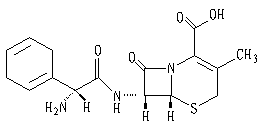
Molecular formula: C 16 H 19 N 3 O 4 S
Molecular weight: 349.41
�Properties】 This product is white or white-like powder.
�Indications】 It
is suitable for respiratory tract infections such as acute pharyngitis,
tonsillitis, otitis media, bronchitis and pneumonia caused by sensitive
bacteria, genitourinary tract infections and skin and soft tissue
infections.
�Specification】 according to C 16 H 19 N 3 O 4 Calculated S (1) 0.5g (2) 1.0 g
[Usage and dosage]
Intravenous infusion, intravenous injection or intramuscular injection,
adults, 0.5~1.0g at a time, once every 6 hours, the maximum dose per day
is 8g. Children (over 1 year old) should be 12.5~25mg/kg once every 6
hours according to their body weight. When the creatinine clearance rate
is greater than 20ml/min, 5~20ml/min or less than 5ml/min, the dose
should be adjusted to 0.5g, 0.25g every 6 hours and 0.25g every 12
hours. When preparing intramuscular injection, add 2ml of injectable
water to 0.5g of bottles, and deep intramuscular injection is required.
When preparing intravenous injection solution, inject at least 10ml of
water for injection or 5% glucose injection into a 0.5g bottle. Inject
within 5 minutes. When preparing intravenous infusion solution, inject
10ml of suitable dilution into a 0.5g bottle, and then further dilute it
with sodium chloride injection or 5% glucose solution.
[Adverse reaction]
The adverse reactions of this product are mild and the incidence is low,
about 6%. Gastrointestinal reactions such as nausea, vomiting,
diarrhea, and upper abdominal discomfort are more common. The incidence
of drug eruption is about 1%~3%, and some patients may have
pseudomembranous enteritis, eosinophilia, positive direct Coombs test,
and peripheral blood picture leukocytes and neutropenia. A small number
of patients may have a temporary increase in blood urea nitrogen and a
transient increase in serum aminotransferase and serum alkaline
phosphatase. The pain of intramuscular injection of this product is
obvious, and phlebitis has been reported after intravenous injection.
Adverse reactions after marketing in China have been reported, and the
use of this product may lead to hematuria, and there have been very few
cases of mental abnormalities, hearing loss, delayed allergy,
anaphylactic shock, dysuria, drug-induced hemolysis, arrhythmia and
other rare adverse reactions such as mental abnormalities, hearing loss,
delayed allergy, anaphylactic shock, dysuria, drug-induced hemolysis,
and arrhythmias.
[Contraindication]
This product is contraindicated for people who are allergic to
cephalosporins and those who have a history of penicillin anaphylactic
shock or immediate reactions.
[Precautions]
1. Before applying this product, the patient must be asked in detail
about the history of allergy to cephalosporins, penicillins and other
drugs, those with a history of anaphylactic shock of penicillins should
not use this product, other patients must pay attention to the chance of
cross-allergic reaction between cephalosporins and penicillins when
applying this product, and should be used with caution under close
observation. If an allergic reaction occurs, stop the drug immediately.
If anaphylactic shock occurs, immediate rescue must be taken on the
spot, including measures to keep the airway open, oxygen inhalation,
adrenaline, glucocorticoids and other measures.
2. This product is mainly excreted through the kidney, and those with
renal function must reduce the dose or extend the interval between
doses. Adverse reactions after marketing in China have been reported,
and the use of this product may lead to hematuria, and children are
susceptible to the disease, so patients with renal dysfunction and
children should be cautious and monitored.
3. Patients who use this product may have false positive reactions when determining urine glucose by copper sulfate method.
[Medication for pregnant and lactating women]
Because this product can enter the fetal blood circulation through the
blood-placental barrier, pregnant women need to have specific
indications for medication. Although there have been no reports of
problems with the use of cephalosporins in lactating women, the pros and
cons must still be weighed when applying.
[Children's medication]
Pediatric (over 1 year old) usage has been clarified in [Dosage].
Adverse reactions after marketing in China have been reported, the use
of this product may lead to hematuria, children are susceptible to the
disease, and pediatric patients should be cautious and monitored when
using this product.
Elderly patients with renal insufficiency should appropriately reduce the dose or extend the dosing interval.
[Drug Interactions]
1. Cephalosporins can delay the excretion of phenytoin in the renal tubules.
2. The combination of phenylbutazone and cephalosporin antibiotics can increase nephrotoxicity.
3. Combined with strong diuretics, it can increase nephrotoxicity.
4. Combined application with metillin, it has a synergistic effect on
Gram-negative bacteria such as Escherichia coli and Salmonella.
5. Probenecid can delay the renal excretion of this product.
[Drug overdose] is not clear.
[Pharmacology and Toxicology]
This product is a first-generation cephalosporin, which has a good
antibacterial effect on some strains of gram-positive cocci such as
penicillinase and penicillinase-producing Staphylococcus aureus,
coagulase-negative staphylococcus, group A hemolytic streptococcus,
Streptococcus pneumoniae and Streptococcus grass aeruginosa. Anaerobic
gram-positive bacteria are more sensitive to this product, and
Bacteroides fragilis is resistant to this product. methicillin-resistant
staphylococcus and enterococcus are resistant to this product. The
effect of this product on gram-positive and gram-negative bacteria is
similar to that of cephalexin. This product has a certain effect on
gonococcus and is also active against enzyme-producing gonococci; Less
active against Haemophilus influenzae.
[Pharmacokinetics]
Intravenous infusion of 0.5g of this product, the blood concentration is
46mg/L after 5 minutes, and the average peak blood concentration (C
max) of 6mg/L after intramuscular injection of 0.5g C is reached 1~2 hours after administration. Intramuscular absorption is
worse than oral injection, but the blood concentration is maintained for
a longer time. The half-life of blood elimination ( t 1/2β)
is 0.8~1 hour. This product is well distributed in tissue fluids. The
concentration in liver tissue is equal to the serum concentration.
Effective concentrations are obtained in the heart muscle, uterus,
lungs, prostate, and bone tissue. The concentration of drugs in
cerebrospinal fluid is only 8%~12% of the blood concentration in the
same period. This product can enter the fetal blood circulation through
the blood-placental barrier, and a small amount is excreted through
milk. The serum protein binding rate is 6%~10%. The cumulative urine
excretion 6 hours after intravenous administration is more than 90% of
the dose; 66% of the administered dose is excreted cumulatively in urine
6 hours after intramuscular injection. The concentration in urine is
very high, often exceeding 1000mg/L. A small amount of this product can
be excreted from the bile, which can be 4 times the concentration of the
serum. This product is rarely metabolized in the body and can be
cleared for hemodialysis and peritoneal dialysis. Probenecid can reduce
renal excretion of this product.
�Storage】 Tightly sealed, stored in a cool and dark place (no more than 20°C away from light).
�Packaging】 Injection bottle + sterile powder for injection is stopped with locally
coated halogenated butyl rubber stopper, (1) 1 bottle per box (2) 10
bottles per box.
Validity: 24 months
[ Implementation standard ] Part II of the 2025 edition of the Pharmacopoeia of the People's Republic of China
[Approval number] (1) Sinopharm standard H44025097 (0.5g).
(2) Sinopharm standard H44025090 (1.0g).
[Drug marketing authorization holder]
Company name: Guangdong Jincheng Jinsu Pharmaceutical Co., Ltd
Registered address: No. 10, Shennong Road, Torch Development Zone, Zhongshan City, Guangdong Province
[Manufacturer]
Company name: Guangdong Jincheng Jinsu Pharmaceutical Co., Ltd
Production address: No. 10 Shennong Road, Torch Development Zone, Zhongshan City, Guangdong Province
Postal code: 528437
Service hotline: 400-9988-970
Telephone number: (0760) 22830525 (switchboard).
Fax number: (0760) 22578279
Website: http://www.gdjcjs.com